
Start with “Authenticator sync or export feature”
Record the change that preceded the problem, where it occurs, the affected app, and the active connection. Holding test conditions constant helps distinguish intermittent service trouble from a persistent configuration issue.
- Authenticator sync or export feature
- Backup codes for each account
- Clock synchronization on both phones
- Post-transfer login test and old registration removal
Separate four layers of authentication: device lock, online account, recovery information, and sync destination. Before disabling protection, verify recovery access from another device and locate backup codes.
Separate “Authenticator sync or export feature” from “Backup codes for each account”
| Layer | How to isolate it |
|---|---|
| Authenticator sync or export feature | Record the current value, automatic state, eligibility, and recent changes, then compare a controlled alternative to isolate Authenticator sync or export feature. |
| Backup codes for each account | Record the current value, automatic state, eligibility, and recent changes, then compare a controlled alternative to isolate Backup codes for each account. |
| Clock synchronization on both phones | Record the current value, automatic state, eligibility, and recent changes, then compare a controlled alternative to isolate Clock synchronization on both phones. |
| Post-transfer login test and old registration removal | Record the current value, automatic state, eligibility, and recent changes, then compare a controlled alternative to isolate Post-transfer login test and old registration removal. |
Diagnostic order for Transfer an Authenticator App Before Resetting a Phone
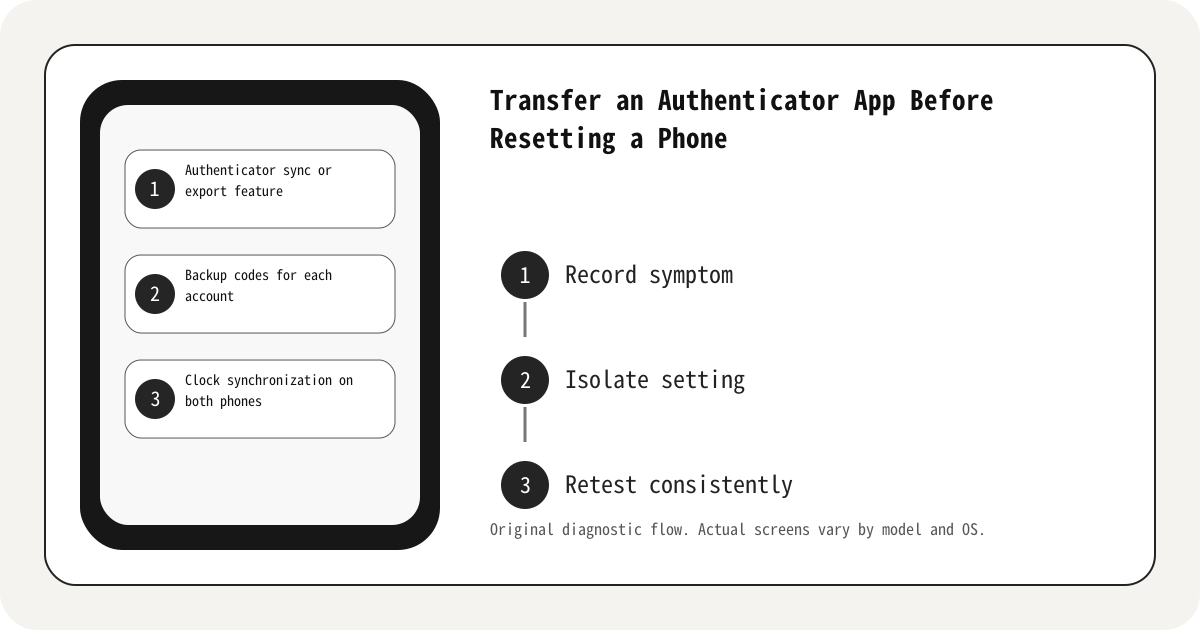
Test one variable at a time
Test one item at a time. After checking “Authenticator sync or export feature,” repeat the same test before moving to “Backup codes for each account.” Stop as soon as Transfer an Authenticator App Before Resetting a Phone works again and record the last change.
- 1Record when Transfer an Authenticator App Before Resetting a Phone occurs and capture “Authenticator sync or export feature” and “Backup codes for each account” at that moment. Save the exact warning text without exposing passwords or activation secrets.
- 2Restart normally, then check only updates that can affect Transfer an Authenticator App Before Resetting a Phone. If the behavior began after an update, preserve that before/after timing as part of the diagnosis.
- 3Use Settings search to open “Authenticator sync or export feature.” Record its current value and whether automatic configuration is enabled before making a change.
- 4Inspect “Backup codes for each account,” then compare another network, SIM, app, accessory, or user profile to determine whether the failure follows the phone or the service.
- 5Confirm that “Clock synchronization on both phones” and “Post-transfer login test and old registration removal” meet device, plan, region, permission, and management requirements. A missing menu can indicate that the feature is not provisioned.
- 6Change only one of “Authenticator sync or export feature” or “Backup codes for each account,” then repeat the same test. Do not combine resets because that would erase the evidence for Transfer an Authenticator App Before Resetting a Phone.
- 7If Transfer an Authenticator App Before Resetting a Phone still fails, collect “Authenticator sync or export feature,” “Backup codes for each account,” “Clock synchronization on both phones,” the model/OS build, and the exact reproduction steps before contacting the provider responsible for that layer.
What to inspect when the basic checks do not explain it
Separate four layers of authentication: device lock, online account, recovery information, and sync destination. Before disabling protection, verify recovery access from another device and locate backup codes.
- Authenticator sync or export feature: Check not only the menu value but also plan eligibility, permissions, management state, and the remote endpoint.
- Backup codes for each account: Check not only the menu value but also plan eligibility, permissions, management state, and the remote endpoint.
- Clock synchronization on both phones: Check not only the menu value but also plan eligibility, permissions, management state, and the remote endpoint.
- Post-transfer login test and old registration removal: Check not only the menu value but also plan eligibility, permissions, management state, and the remote endpoint.
Do not erase the evidence before isolating the cause
- For Transfer an Authenticator App Before Resetting a Phone, do not copy configuration values or profiles from an unverified source.
- Do not bulk-delete networks, accounts, certificates, or profiles while diagnosing Transfer an Authenticator App Before Resetting a Phone; first identify whether “Authenticator sync or export feature” or “Backup codes for each account” is involved.
- Do not erase the phone or disable account protection for Transfer an Authenticator App Before Resetting a Phone until recovery access and the effect on “Authenticator sync or export feature” are confirmed.
Keep the evidence needed for the next occurrence
- Keep a short change log for Transfer an Authenticator App Before Resetting a Phone, including the value of “Authenticator sync or export feature,” incident dates, and update dates.
- If Transfer an Authenticator App Before Resetting a Phone involves account recovery, keep recovery codes and essential account details outside the phone in a secure location.
- Before major updates that could affect Transfer an Authenticator App Before Resetting a Phone, verify backups and compatibility for “Authenticator sync or export feature” and “Backup codes for each account.”
Frequently asked questions
Does a missing setting mean the phone is broken?
Not necessarily. The menu can be hidden by OS version, hardware support, region, carrier provisioning, plan eligibility, or device management.
Should I reset settings immediately?
No. A reset is a late-stage isolation step. First record current values and confirm what must be reconfigured afterward.
Why does the same model show a different menu?
OS builds, manufacturer skins, carrier configuration, language, region, and work profiles can change both labels and menu placement.
Did this guide help resolve the problem?
The response is used only to prioritize article improvements. No personal details or typed content are collected.
One response per article is recorded during the current browser session.